Portfolio
Released Games

Horizon Burning Shores Gameplay Trailer
Responsibilities
- Pitched several prototypes
- The unstable firegleam prototype was adopted. The burning shores is a mostly uninhabited place. Unlike the previous game, traps thus had to made out of natural occuring things. The unstable firegleam offered a solution for building natural traps by exploding ruins and rocks to damage enemies.
- Wrote a script in both maya and decima that enabled vegetation placed on the Horus end boss in maya to be ported to our engine with minimal effort.
- Improved player interaction on the skiff (a boat you drive)
- Added realistic movement to distant LOD of Buoys and debris that are floating in the sea.
- I was put unto a new project after the pre production of Burning Shores. I helped out on the Horus and helped fix bugs at the end of the project.

Horizon Forbidden West Gameplay Trailer
Responsibilities
- Throughout the development I was responsible for the technical design of the Plasma Spine, Leap Lasher, Wide Maw, Sunwing and Anteater.
- For the attacks: Defining and spawning the damage volumes, projectiles and their behavior, creating placeholder vfx and hooking them up.
- Setting up the destructibility of the machines. This means the player can damage and detach parts of the machine. I would also script how part destruction would influence the behaviour and state of the robot.
- Optimizing the collision hulls on all machines to make target evaluation more performant, resulting in less hitches.
- Receiving meshes, then adding vfx, rigs, animations and logic to make objects interactive. ie: switches, doors, pullables, destructibles, traversables, elevators, traps.
- Visual scripting in the Decima engine using node graphs and state machines.
- Setting up propotypes for designers, then iterating together with them over the design and implementing changes.
- Held a workshop for designers to increase their knowledge, resulting in more robust prototypes on their end.
- Initiated a knowledge exchange with a sister studio using the same engine. I went to their studio and held a couple of workshops.
- Writing up feature requests for the tools team to improve editor workflow.
- Wrote a python script to automize the exporting of vegetation assets on the horus boss fight of The burning shores DLC. This saved lots of tedious manual labour.
- Contributed to a library of functions to help other technical designers create content quicker. ie: A node where you input a radius, orientation and a nr of points and then outputs the world positions of points on a circle. This to easily be able to spawn items in circular patterns.
- Organized weekly football and halloween horror movie viewings.

Watch Gameplay video - himalaya track (most intense level)
Responsibilities
- Level LOD setup
- Performance analysis (GPU,CPU,Memory)
- Asset optimisation
- Audio integration
- Blueprinting
- Minor VFX
Read more on performance profiling

Responsibilities
- Improved pointer and gaze UI navigation.
- Did the setup on the Unreal engine side for localisation. (translations in other languages)
- Created diary snippet component that can be standalone or attached to an object.
- Improved the way the devs would navigate the project, so alterations were more easily made.

EuroFishing trailer
Responsibilities
- Rigged and skinned main character, fishes and equipment.
- Created a detailed face rig.
- Created a fish variation system using blendshapes, material changes and joint offsets.
- Build water shader with wind, gust and rain effects.
- Blueprinting (visual scripting)
- Created a time of day system that drives sun, moon, lights, sky, and fog.
- Created clouds and rain fx.
- Responsive foliage, particles, splashes.
- Wrote a couple of pymel scripts for animator.
- Build layered paintable landscape material, that responds to slope and rain and snow amount.
- Volumetric smoke FX.
- Researched rig lodding and AI behavior.
- Rig setup that enabled clothing and face model swapping.

Responsibilities
- Create a landscape material holding several different layered materials, which you can easily paint on you terrain. The material changes based on slope amount. Rain and snow will affect all layered materials.
- Made a prototype for train station AI character navigation.
- Researched how to create LODs for rigged characters, optimizing their animation costs.
Technical Art
My main rigging skills are included in the 2014 demoreel.
Click here to view my 2014 rigging demoreel
Here is an additional video for a reposable rig.
Click here to view a demonstration video
Reposable rig
This rig features an extra parent layer which changes the space in which the regular controls move. This preserves the animation and allows for easy adjustments to the rig when for example a characters chest is widened or other proportions are changed.
This also makes for an easy to setup template that can be used for all characters that share the same joint hierarchy but have different proportions.
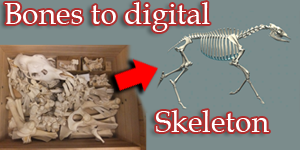
As my graduation project I digitized a box of okapi bones and made it come alive.
The Digital Okapi
This project revolved around digitizing a real okapi skeleton for my graduation project. I took the initiative to contact a natural history museum in Holland called Naturalis. I was allowed to work on one of their skeletons, but it had to be done inside the storage chambers of Naturalis itself. There were few skeletons suitable for digitizing. We chose the okapi for the skeleton was of nice quality, the bones were not too big or too small and because it wasn't a very known animal, which would make my work unique.
I used the microscribe 3d digitizer, which was the only option i had at that time. (a student can't afford a new digitizer) It took me 3,5 months before i had digitized 100 unique bones. It took another 2 months to clean up the raw date as shown in the video. In the end I assembled the skeleton and added a blue mesh to represent the cartilage between the ribs. I also wrote a paper on digitizing skeletons.
The research i did into this animal and its closest relative, the giraffe, has given me a greater insight in animal anatomy, behaviour and locomotion.
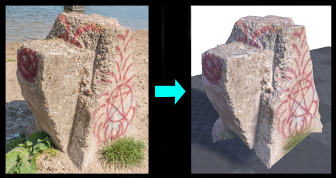
I was tasked to research photogrammetry and document the workflow I defined.
Click on 'Read more' to see more details on my photogrammetry tests.
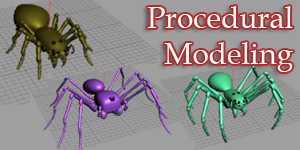
Procedural Spiders in Houdini
What are procedural systems?
Procedural Systems are tools that are built to make a task easier and faster.
Building the tool takes some time, but once it's build, it can fulfill a task within the click of a button.
My procedural modelling tool: Spider Generator
For the procedural modelling class I had to make a tool which could randomly produce varieties of the chosen subject, specifically in proportions, without loosing its 'structure'.
Many chose static objects like buildings or guns, but to challenge myself I picked an organic subject; the spider.
The system creates spiders with different proportions in various parts of the body, without detaching those parts.
Each generated spider can be easily adjusted to the liking of the user.
Click here to view a demonstration video of the tool
Research document
This document shows the research I did on spider varieties and their structural system.
Procedural Spider Generator Document
Art
"I'm right here" music video
Animated most shots of the second half of the video
Animation of okapi skeleton
I animated an ambling walking gait and gallop gait for the okapi skeleton I built.
Animation Reel Playlogic
Several animations I've made for the game EyePet during my internship at Playlogic